Friday, March 18, 2016

Human Trafficking: Lifting the Veil on Modern-Day Slavery Panel at ACIR

A few months ago I was asked to moderate a panel titled "Human Trafficking: Lifting the Veil on Modern-Day Slavery" for the Atlanta Council on International Relations that included Susan Coppedge the Ambassador-at-Large, Office to Monitor and Combat Trafficking in Persons, U.S. Department of State and Camila Wright the Human Trafficking Prosecutor, Georgia Office of the Attorney General. The panel took place today and the whole event was such a great opportunity that I kept pinching myself because I did not really believe it was real.

Here I am giving some introductory remarks on human trafficking and the scope of the crime around the world and in Georgia. Then I followed that up with some overarching themes from both speakers and finally a call to action to the participants and the Georgia Cares 24 hour hotline 1-844-8GA-DMST. I was able to meet so many different people and see a number of familiar faces from the Georgia Statewide Human Trafficking Task Force.

This is me speaking to Blegina Agolli from the Albanian Ministry of Justice.
This is me and Ambassador Coppedge who invited to the unveiling of the 2016 Trafficking In Persons Report this summer while I am in DC which is basically equivalent to the NFL draft for anti-trafficking researchers like me!
The view of downtown Atlanta from the venue at the City Club of Buckhead.

Tuesday, March 15, 2016

Anti-Trafficking Institutions in Human Trafficking Policymaking

Currently, I am taking a class about online teaching through our Center for Instructional Development at Clayton State. I have learned a lot about teaching such as establishing course objectives and aligning them with substantive items that actually achieve that objective. While this is basic stuff for K-12 teachers we really do not receive a lot of this kind of training in higher education. Since I work at a teaching institution it has been great to learn about ways to improve my teaching through online technology. Our assignment this week was to make an infographic to give students another way to learn the material. Since most of the complex material for American Government already has infographics I decided to make one to display my own research. I am working on a paper looking more at the role of anti-trafficking institutions  in human trafficking policymaking and here is an infographic that displays my findings!


Friday, March 11, 2016

Summer in Washington DC!

I found out recently that I will be spending the summer in Washington DC at the Kennan Institute part of the Woodrow Wilson International Center for Scholars. I received a Title VIII Summer Research Fellowship to work on my book tentatively titled Beyond the Natasha Effect: Determinants of Human Trafficking Policy Variation in the Post-Soviet Region. Looking forward to writing my book while also attending/visiting interesting lectures, museums, and monuments!

Saturday, March 5, 2016

2016 Frank Church Symposium

I was invited to present at the 2016 Frank Church Symposium at Idaho State University in Pocatello, Idaho this week. The symposium was sponsored by the Idaho State University International Affairs Council (IAC), and it was completely student run and organized. It was one of the best symposiums I have ever attended as the delegates were treated so well by the students with fabulous food and stimulating conversation throughout the three day event. It was also great to see so many community members show interest in the event and I met many local Rotarians who were so nice and excited to hear about my experience as an Ambassadorial Scholar in Ukraine. I gave two talks at the symposium. The first was titled "Gendered Consequences of War and Peacemaking" and highlighted women's evolving role in conflict and some of the gender based violence outcomes of conflicts around the world. Here is another photo from the panel.

The second day I gave a presentation titled "Responsiveness to Forced Migration: Refugees and Internally Displaced Persons." This presentation was on a wider panel about refugees and displaced people around the world and all of the presentations melded well together. I really enjoyed visiting Pocatello and seeing some of my graduate school friends who were also presenting at the symposium or teach in Idaho. 

Thursday, February 25, 2016

Ukrainian State Programme of Combating Trafficking until 2020

Since my current book project looks at why countries adopt human trafficking policy I always find it interesting when one of my case studies adopts a new law related to human trafficking. Before I went to Ukraine in 2013 it was really difficult to find out about the kinds of trafficking laws that they had. It took me a while to weed through things and locate the laws in a brand new country. Fast forward to 2016, after two research trips to Ukraine, I found out that they adopted a new State Programme of Combating Trafficking until 2020 from the Ministry of Social Policy's facebook page! It is amazing how much more transparent the new regime is on new policy adoptions and that after living there and conducting research how much easier it is to find out this information.

We have been waiting for the new state programme to be adopted since the end of the last state programme ended in 2015. When I visited Ukraine last summer the Ministry of Social Policy seemed very preoccupied with the Internally Displaced Persons crisis and their attention was shifted elsewhere. So it was great to see that on February 24, 2016, the Cabinet of Ministers of Ukraine adopted the Resolution "On approval of the State Programme of Combating Trafficking 2020." This programme will determine the Ukrainian government's work to combat trafficking over the next four years. It outlines a number of specific measures to combat human trafficking and gives a number f responsibilities to the central and local executive authorities. The goal of the state programme is to "prevent human trafficking, increasing the efficiency of detection of persons who commit the offense or contributing to their occurrence, protection of and assistance to victims of trafficking" (Ministry of Social Policy 2016). Since I look for the reasons why countries adopt policy it was interesting that the Ministry identified that it was "developed in pursuant to paragraphs 50 and 51 of the National Action Plan to implement the second phase of the Action Plan to liberalize the EU visa regime for Ukraine" (Ministry of Social Policy 2016). Which supports the argument in my book that the biggest influence on Ukraine with respect to policy adoption was the EU visa free regime.

Wednesday, February 24, 2016

Thomas Remington's visit to Clayton State

In an earlier post I discussed the grant I received from the Critical Language Scholarship (CLS) Alumni Development Fund at American Councils and the U.S. Department of State. For the grant I organized a Current Issues in the Post-Soviet Region Lecture Series and the culmination of that series was Thomas Remington's visit to Clayton State and his talk "Remaking the Social Contract in Russia." I first read Remington's work during my Politics in Russia class in undergrad and continued to read his research on institutions in Russia throughout my graduate career. When I received the grant Remington who is the Goodrich C. White Professor of Political Science at Emory University was the first person on my list of possible speakers and I was so happy when he accepted the invitation to come and speak. I am using the seventh edition of his Politics in Russia book in my POLS 4800 Post-Soviet Politics class this semester and so it was also great to give my students the opportunity to meet the author of their textbook as well. The visit went great, my students found his talk informative, and a number of CSU faculty including the Dean showed up for the talk. Remington was so humble and nice and it was great to meet someone who has made such a profound impact on the field and remained nice and down to earth in the process.

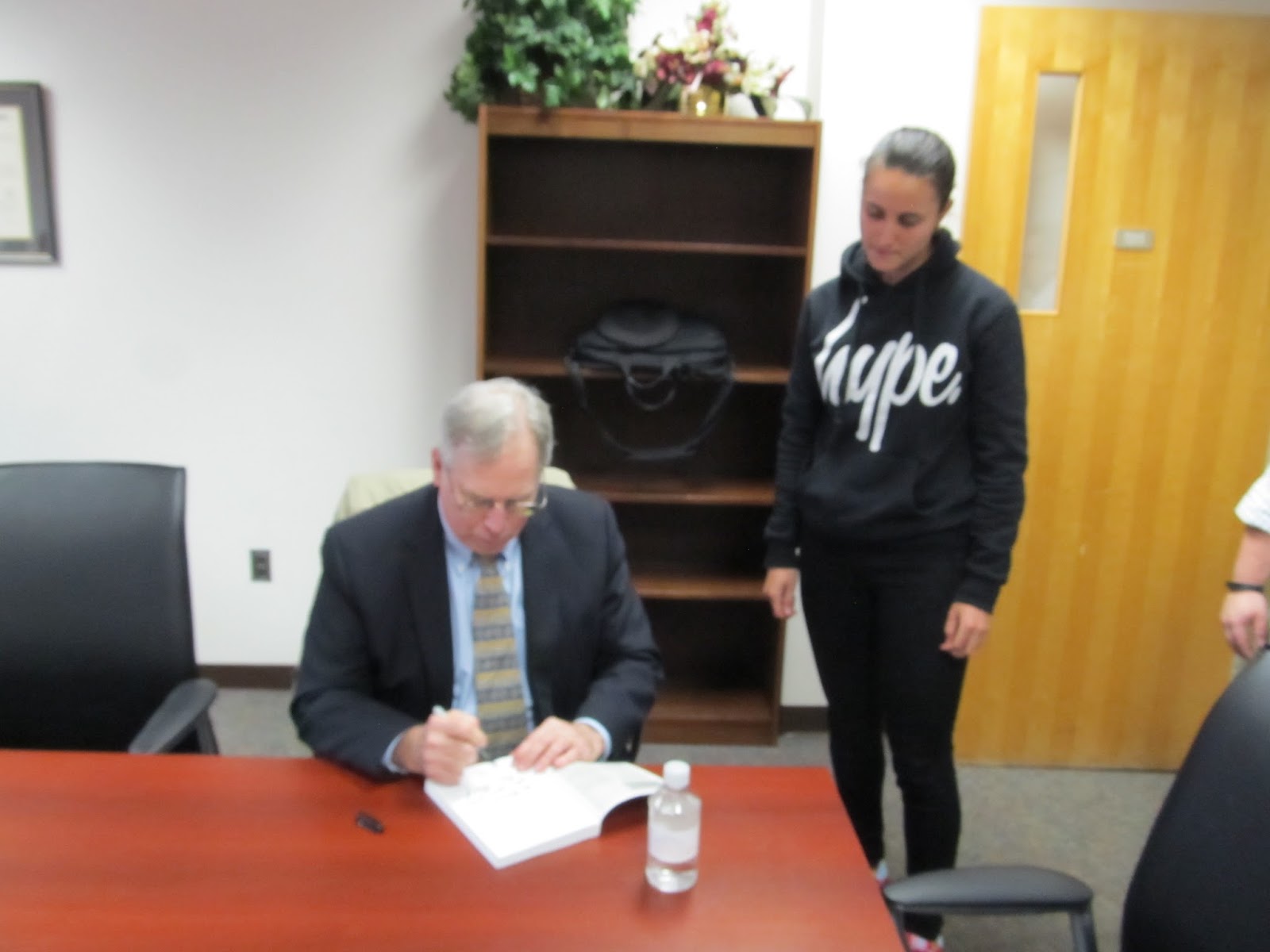
Thomas Remington autographing his book for one of my students

Me and Thomas Remington!


Tuesday, February 23, 2016

Assessment of County Level Human Trafficking Protocols

I was tasked to examine county level protocols on human trafficking for the Clayton County CEPR Multi-Disciplinary Team. A county level protocol directs people to resources and Clayton county is the county where I live and teach and so I have a vested interest in human trafficking work in the county where I live. The multi-disciplinary team related to the Commercial Sexual Exploitation of Children (CSEC) has been meeting for almost a year and works to investigate trafficking offenses, as well as, facilitate judicial proceedings for the prosecution of traffickers and help the victims. To my surprise there were no other county level protocols on human trafficking in Georgia. Further investigation revealed that county level protocols were relatively rare around the United States. Only nine county level protocols from different counties around the United States were located from counties such as Ross County, Ohio; Cook County, Illinois; San Mateo County, California; Howard County, Maryland; San Francisco, California; Orange County, California; and Lucas County, Ohio. All of the protocols were formulated by county-level human trafficking task forces. 

Here are a few of the findings from my research. The main components of the protocols included a mission statement, scope of the problem, different types of responsibilities allocated to law enforcement, victims service providers, criminal justice authorities, and education and community initiatives. All of the protocols/policies were adopted in the past two years. Some of the bigger counties around the United States such as Kind county in Seattle rely on state level protocols. All of the protocols promote a collaborative approach with multiple stakeholders from different agencies and these stakeholders have clearly defined roles in the protocol. New Jersey outlines the county level task forces/coalitions protocols "are very helpful, we have also learned from experience as well as from our counterparts in other parts of the country that building personal relationships and trust among those professionals working to combat and respond to trafficking is the most critical step. From that, protocols may emerge but it is the ability to be flexible and to respond to the unique circumstances of every case that brings value to the process." 

This cursory research will help the team develop the first county level human trafficking protocol in Georgia. We are set to discuss and examine a rough draft of the protocol that I am working on with my graduate student in April.